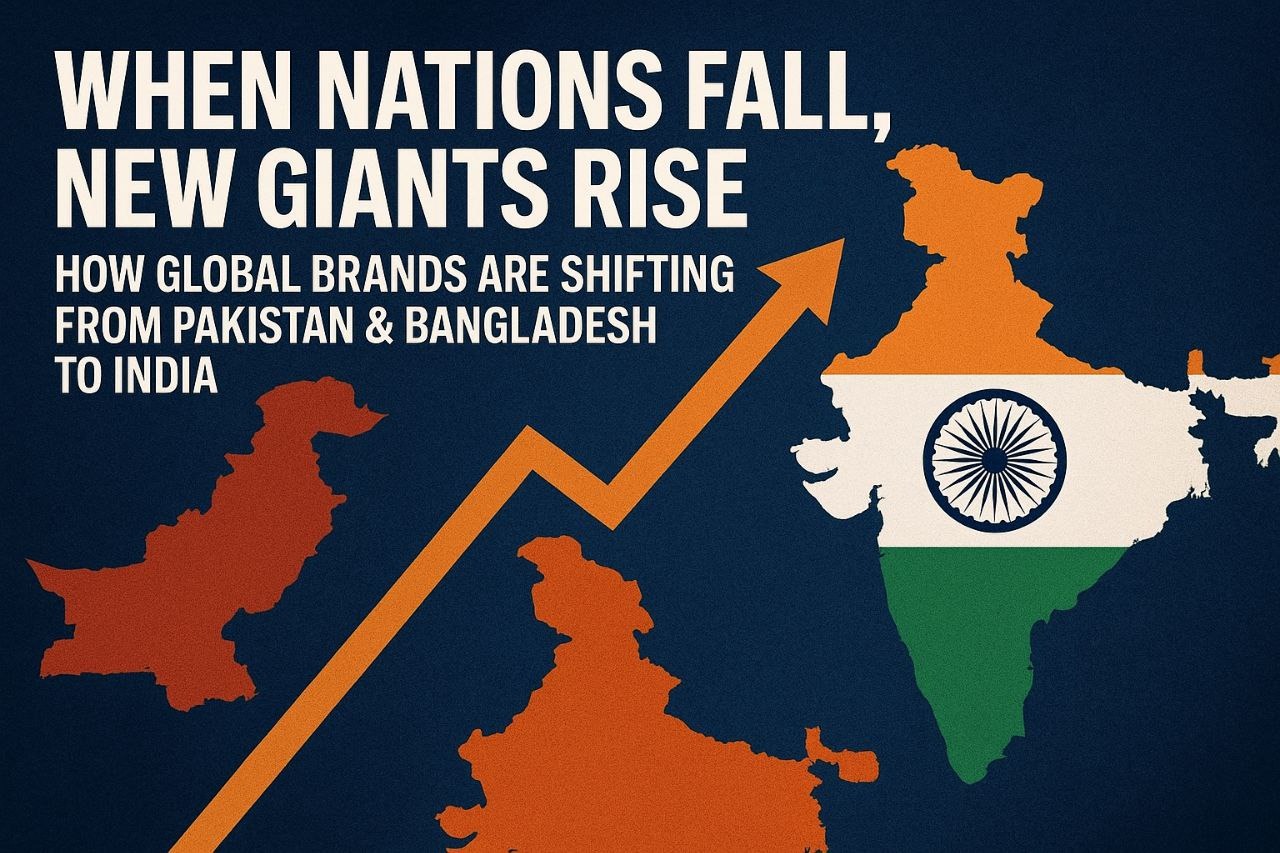
When Nations Fall, New Giants Rise: How Global Brands Are Shifting from Pakistan & Bangladesh to India
In a world reshaped by economic turbulence, collapsing manufacturing ecosystems, supply-chain risks, political unpredictability, and shifting geopolitical alliances, an undeniable truth emerges:
Global brands are quietly, and in many cases, aggressively, rerouting their investments, production capacity, technology infrastructure, and manufacturing footprints away from Pakistan and Bangladesh… and redirecting them toward India.
This tectonic shift isn’t accidental. It’s a reflection of deeper global realignment.
“Economies don’t collapse overnight; they collapse in the imagination of investors long before the numbers appear on charts.” ~ Adarsh Singh
India today is not merely a developing economy; it is fast becoming the world’s alternative manufacturing powerhouse, a technology adoption leader, and a supply-chain stabilizer. While Pakistan and Bangladesh struggle under pressure, India appears increasingly resilient, attractive, and strategic.
Let’s dive deep: economically, politically, socially, historically, spiritually, and practically.
I. The Collapse of Pakistan: Where Political Instability Meets Economic Reality
Pakistan’s decline has been gradual yet persistent:
1. Political Instability
Frequent government collapses, military interference, and revolving-door leadership signal high risk, low predictability, the worst combination for global capital.
2. IMF Dependency
Repeated bailouts create a global perception of fragility.
3. Currency Freefall
The Pakistani Rupee’s depreciation shrinks profit margins for foreign companies. No brand invests where profits evaporate in exchange-rate volatility.
4. Terror Ecosystem
Brands hate unpredictability. Logistics, labor safety, and investment security are all at risk.
5. Import Limitations
Pakistan has struggled to import even basic manufacturing materials due to forex shortages, causing production shutdowns.
This is not a temporary slump; it’s a structural problem.
“When a nation builds an economy on uncertainty, the first to flee are the brands, and the last to return are investors.” ~ Adarsh Singh
II. Bangladesh’s Looming Crisis: A Textile Titan in Trouble
Bangladesh built its economy on textiles, an industry highly sensitive to:
✽ Labor strikes
✽ Supply chain disruptions
✽ Compliance violations
✽ Energy shortages
As global compliance standards rise, Bangladesh faces:
1. Political Crackdowns
Recent authoritarian shifts have created fear of sanctions.
2. Export Market Slowdown
Dependency on Europe and America is dangerous when those markets slow consumption.
3. Wage Pressure
Labor cost advantages are shrinking.
4. Safety Concerns
Even years after the Rana Plaza tragedy, compliance remains under scrutiny.
Bangladesh is not collapsing, but shrinking competitiveness is real.
III. The Global Brand Perspective: Risk is the New Tax
Modern corporations operate on these mantras:
✽ Political stability
✽ Currency stability
✽ Demand growth
✽ Policy continuity
✽ Skilled labor availability
Pakistan fails on most. Bangladesh struggles. India scores high, and rising.
Brands are not emotional; they are algorithmic. They follow signals.
IV. Why India Attracts Global Growth Now
1. Stable Governance
A decade of stable leadership creates policy predictability.
2. Huge Domestic Consumption
India isn’t just a production base, it’s a massive buyer. No need to ship everything abroad.
3. Demographic Dividend
Young workforce = Sustainable labor supply.
4. Rising Tech Talent
AI, robotics, automation, chip design, India is present.
5. Logistics Revolution
New highways, freight corridors, ports, airports, India is becoming faster.
6. China-Plus-One Strategy
Global firms want diversification. India is now the #1 beneficiary.
7. Investor Confidence
Record FDI inflows across sectors.
This is not luck. It’s a compounding strategy.
V. The “Brand Stampede” Toward India
Recent indicators:
✽ Apple shifting iPhone production to India
✽ Tesla negotiating manufacturing entry
✽ Samsung expanding capacity
✽ Global retailers increasing India sourcing
✽ Microchip companies setting manufacturing labs
✽ Defense giants partnering with Indian firms
What started slowly is now accelerating sharply. A turning point has arrived.
VI. The Spiritual Dimension: Energy Moves Toward Stability
Civilizations rise not only through GDP numbers, but through collective consciousness.
Countries radiate:
✽ Confidence
✽ Fear
✽ Order
✽ Chaos
✽ Harmony
✽ Hostility
The global economy senses these energies.
India’s civilizational rootedness provides a spiritual foundation for economic resilience.
“Where a society’s inner life is stable, outer prosperity becomes inevitable.” ~ Adarsh Singh
VII. India as the New Workforce Magnet
Unlike Pakistan and Bangladesh, India has:
✽ World-class universities
✽ Startup accelerators
✽ Corporate training infrastructure
✽ Skilled professional culture
The world needs talent more than ever. India has it, abundantly.
VIII. Manufacturing + Services = A Rare Dual Engine
Most countries have one:
✽ China = Manufacturing
✽ USA = Services
✽ Bangladesh = Textiles
India is unusual:
✽ IT Exports
✽ Manufacturing expansion
✽ Startup ecosystem
✽ Robotics and EV push
✽ Defense modernization
This dual-engine economy is futuristic.
IX. Comparing Business Ecosystems
Pakistan
✽ Instability
✽ Terror risks
✽ Forex crisis
✽ Military influence
Bangladesh
✽ Single-industry dependency
✽ Political clampdown
✽ Compliance weaknesses
India
✽ Policy continuity
✽ Tech adoption
✽ Infrastructure growth
✽ Rising consumption
✽ Global alignment
It’s not emotional, it’s rational.
X. The Geopolitical Angle
Pakistan and Bangladesh both operate under geopolitical shadows:
✽ Funding from Gulf interest blocs
✽ Reliance on external credit
✽ Strategic ambiguity
But India is:
✽ Partnered with the US, Japan, EU
✽ Engaged in QUAD
✽ Aligned for semiconductor supply chains
✽ Strategic clarity = Investor magnetism.
XI. Supply Chain Shock proofing
Brands learned hard lessons from:
✽ Covid shutdowns
✽ China lockdowns
✽ Shipping crises
✽ War disruptions
India offers:
✽ Multiple ports
✽ Domestic consumption buffers
✽ Flexible regulation
✽ Digital tracking
✽ Large vendor ecosystems
Brands want resilience, not just cheap labor.
XII. Rising Middle Class: The Untold Engine
India will add more middle-class consumers than entire continents over the next 10 years.
✽ Consumption = Gravity.
You cannot fight gravity.
XIII. Digital Governance: India’s Ace Card
✽ Aadhaar
✽ UPI
✽ FASTag
✽ GST Network
These aren’t apps. They’re national infrastructure.
Bangladesh and Pakistan simply don’t have a digital governance scale.
This reduces:
✽ Corruption
✽ Middlemen
✽ Documentation delays
Global brands love automation.
XIV. The Soft Power Factor
✽ Movies
✽ Yoga
✽ Ayurveda
✽ Cricket
✽ Indian diaspora CEOs
All of these elevate trust.
Pakistan lacks soft power. Bangladesh is limited. India is exploding.
XV. Labor Laws Modernization
Reformed labor codes encourage:
✽ Hiring flexibility
✽ Shift scheduling
✽ Contractual specialization
Foreign companies notice.
XVI. FDI Flows Speak Louder Than Words
✽ Money doesn’t lie.
✽ Billions are relocating.
✽ Factories follow capital.
XVII. EV & Semiconductor Boom
Pakistan doesn’t have this sector. Bangladesh is years away.
India is already:
✽ Producing EV vehicles
✽ Building battery ecosystems
✽ Attracting chip fabs
This is future-proof positioning.
XVIII. Venture Capital Psychology
VCs invest in:
✽ Democracy
✽ Innovation
✽ Talent pools
India checks every box.
Pakistan’s startup funding collapsed. Bangladesh slowed dramatically.
Investors fear uncertainty more than loss.
XIX. Cultural Mindset: Discipline vs. Dependency
Indian culture values:
✽ Education
✽ Competition
✽ Self-improvement
✽ Entrepreneurship
✽ Spiritual grounding
When collective identity rises, industries rise.
“Prosperity begins first as a mindset, and only later becomes an economy.” ~ Adarsh Singh
XX. Why This Shift Will Continue for a Decade
This is not temporary.
✽ Youth demographics
✽ Infrastructure buildup
✽ Foreign partnerships
✽ Digital identity
✽ Regulatory reform
These are compounding drivers.
XXI. The Domestic Brand Multiplier
When foreign brands partner with India:
✽ Local vendors upgrade
✽ Local logistics mature
✽ Local talent evolves
This triggers decades of ripple-effect improvement.
XXII. Pakistan & Bangladesh Cannot Catch Up Fast
Even if they try, structural gaps include:
✽ Energy constraints
✽ Education quality
✽ Governance reforms
✽ Digital infrastructure
It takes decades to build these. India started early.
XXIII. The Ethical Dimension
Brands today care about:
✽ Sustainability
✽ Human rights
✽ Women in workforce
✽ Data privacy
India’s ethical compliance record is rising. Pakistan is falling. Bangladesh’s struggles continue.
XXIV. Indian Consumers: The Final Pull
Brands go where buyers exist.
India’s urbanization + rising incomes = unstoppable consumption arc.
XXV. Lessons for Indian Citizens
What should we do?
1. Skill Up
AI, robotics, automation, prepare.
2. Support Local manufacturing
Demand creates factories.
3. Stay entrepreneurial
This is the decade of risk-taking.
4. Vote consciously
Stability is economic oxygen.
5. Protect national identity
Civilizational confidence creates international respect.
XXVI. A Warning for India
Growth brings danger:
✽ Complacency
✽ Consumerism
✽ Internal division
We must avoid these traps.
XXVII. The Spiritual Responsibility
✽ The world is watching India rise, responsibly.
✽ Our DNA is not aggression. It is wisdom.
✽ We must grow without losing soul.
“True strength is not expansion; it is elevation.” ~ Adarsh Singh
XXVIII. The Global Future
By 2035, analysts predict:
✽ India = 3rd largest economy
✽ Manufacturing share doubled
✽ Semiconductor export hub
✽ Startup capital of the world
✽ Massive middle-class consumption
Meanwhile:
✽ Pakistan is expected to shrink financially.
✽ Bangladesh will stagnate without diversification.
This is a fork in history.
XXIX. The Consciousness Wave
India’s youth are increasingly:
✽ Nationalist
✽ Ambitious
✽ Technologically skilled
✽ Spiritually inclined
That combination is rare.
XXX. The Decade of India
This moment is once in 300 years.
Don’t miss it.
# India Attracts the World Not by Chance, but by Maturity
The collapse of others is not India’s opportunity.
India’s opportunity comes from:
✽ Its discipline,
✽ Its patience,
✽ Its strategy,
✽ Its culture,
✽ Its spirituality.
But when collapsing economies push global brands to re-evaluate risk, India becomes the natural choice.
Because India is not merely growing, India is maturing.
“Nations don’t rise on GDP; they rise on collective consciousness, courage, and character.” ~ Adarsh Singh
And that is why global brands are coming.
Not because Pakistan or Bangladesh are falling……but because India is finally rising.
“The world follows power, but power follows stability. When a nation becomes stable within, every opportunity in the world walks toward its doors.” ~ Adarsh Singh
Tue Nov 25, 2025
 Launch your Graphy